Energy Use in the Residential Sector







The Office of Energy Efficiency at Natural Resources Canada has changed the base year from 1990 to 2000. This change was made to ensure that our data reflects developments in trends and structures of Canada’s energy end use and efficiency across sectors. It also synchronizes reporting on Canada’s energy use data with changes made by the International Energy Agency.
Highlights
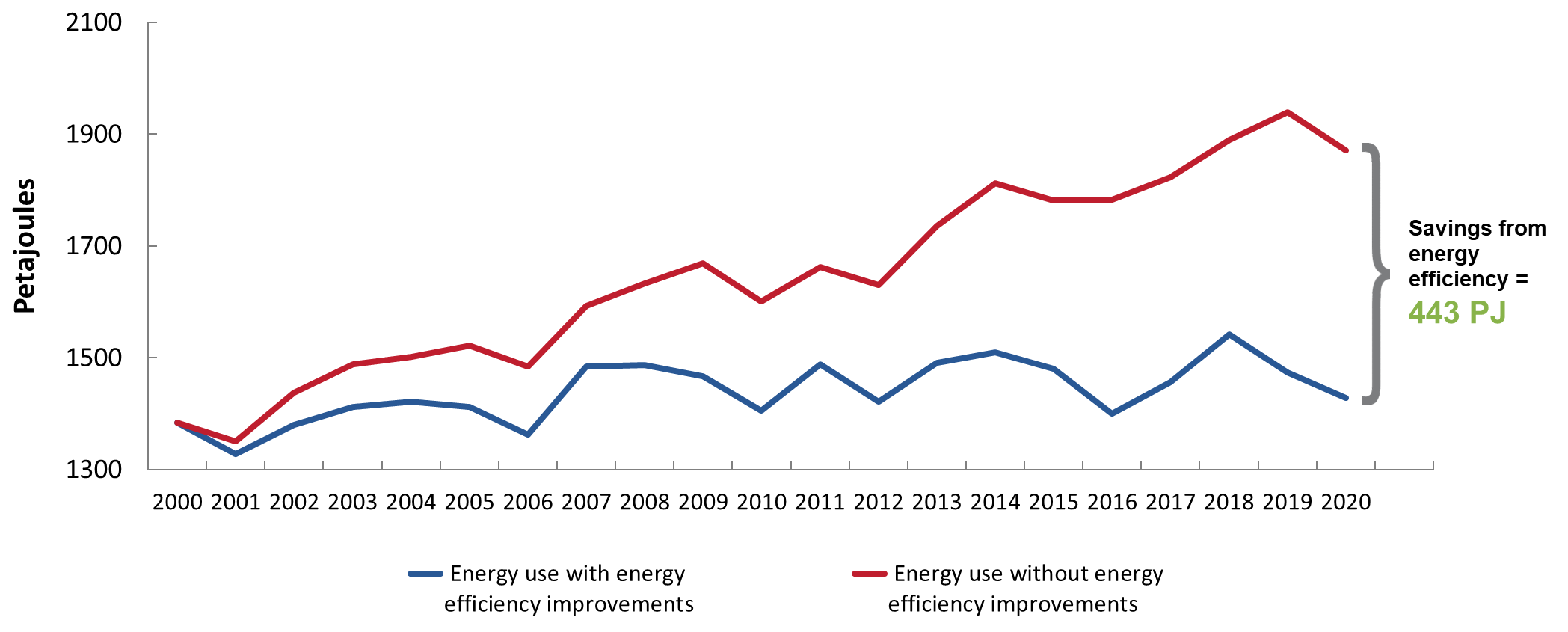
- Energy efficiency in the residential sector improved 32%, saving Canadians 443 PJ in energy and $8.7 billion in costs – averaging $49 per household per month.
- Residential energy use increased 3.2% in 2020, but it would have increased 35.2% without energy efficiency improvements.
- Energy efficiency helped avoid 17.7 Mt in GHG emissions.
 Overview
Key drivers for residential energy consumption
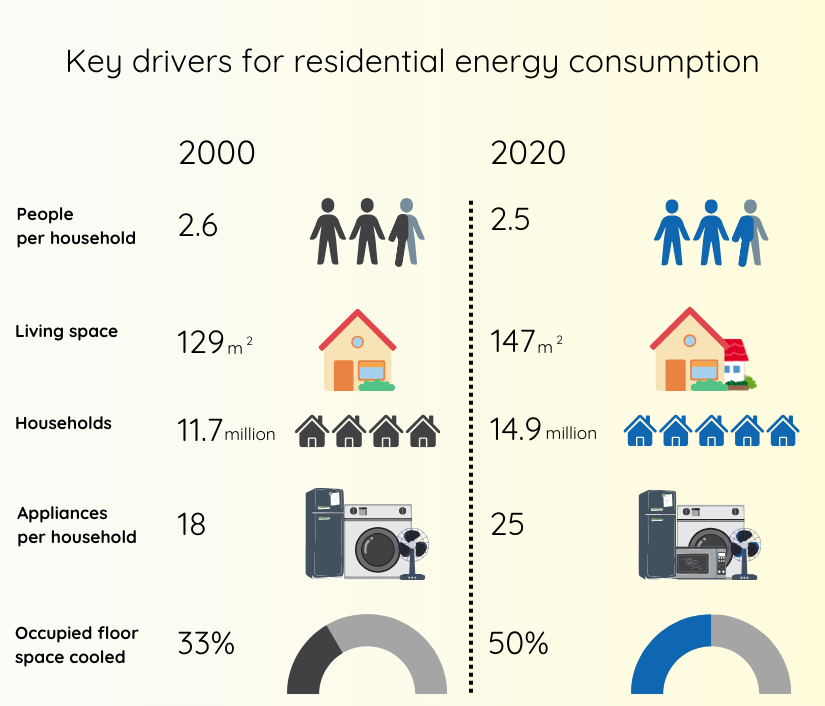
Text version
Key drivers for residential energy consumption
| 2000 | 2020 | |
|---|---|---|
| Household Numbers (million) | 11.7 | 14.9 |
| Living space per household (m2) | 129 | 146 |
| People per household | 2.6 | 2.5 |
| Appliances per household | 18 | 25 |
| Occupied floor space cooled (%) | 33 | 50 |
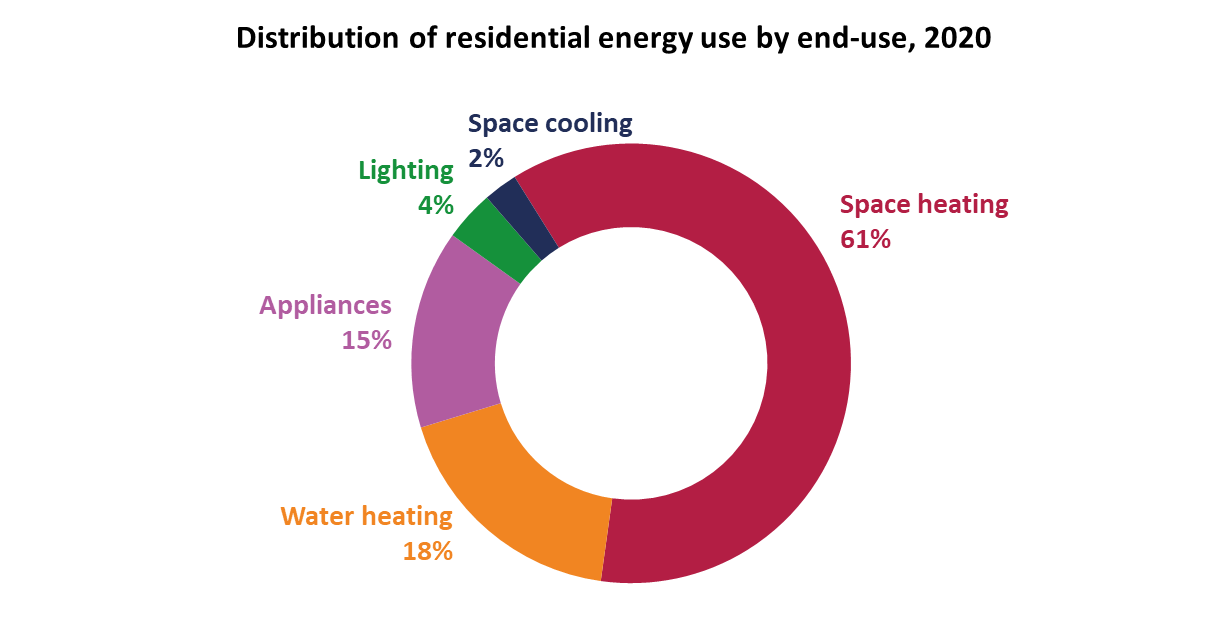
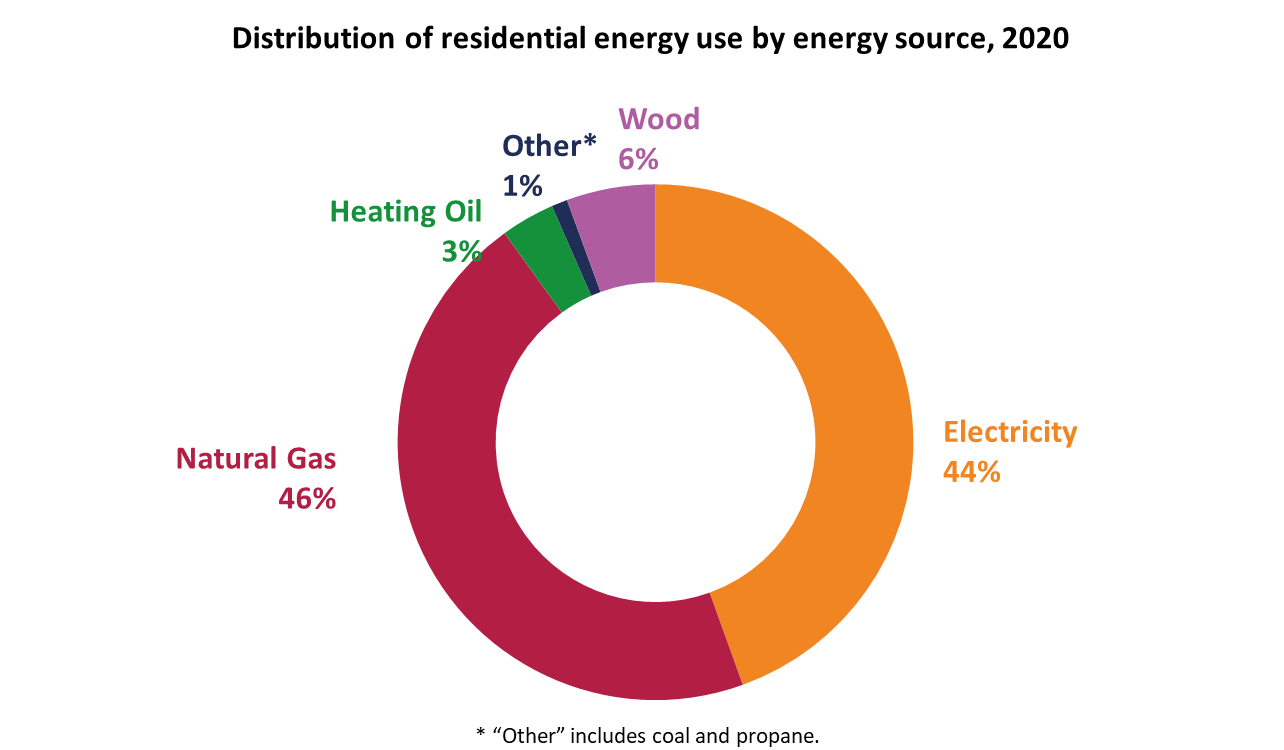
Canadians spent $28.1 billion on energy in their homes in 2020. Most of the energy (79%) was used for space and water heating. The predominant fuels were natural gas, electricity, and home heating oil. Other fuels included wood and propane.
Text version
Distribution of residential energy use by end use, 2020
| Residential energy use | Percentage |
|---|---|
| Space heating | 61 |
| Water heating | 18 |
| Appliances | 15 |
| Lighting | 4 |
| Space cooling | 3 |
Text version
Distribution of residential energy use by energy source, 2020
| Energy source | Percentage |
|---|---|
| Natural gas | 46 |
| Electricity | 45 |
| Wood | 6 |
| Heating oil | 3 |
| Other Footnote * | 1 |
Text version
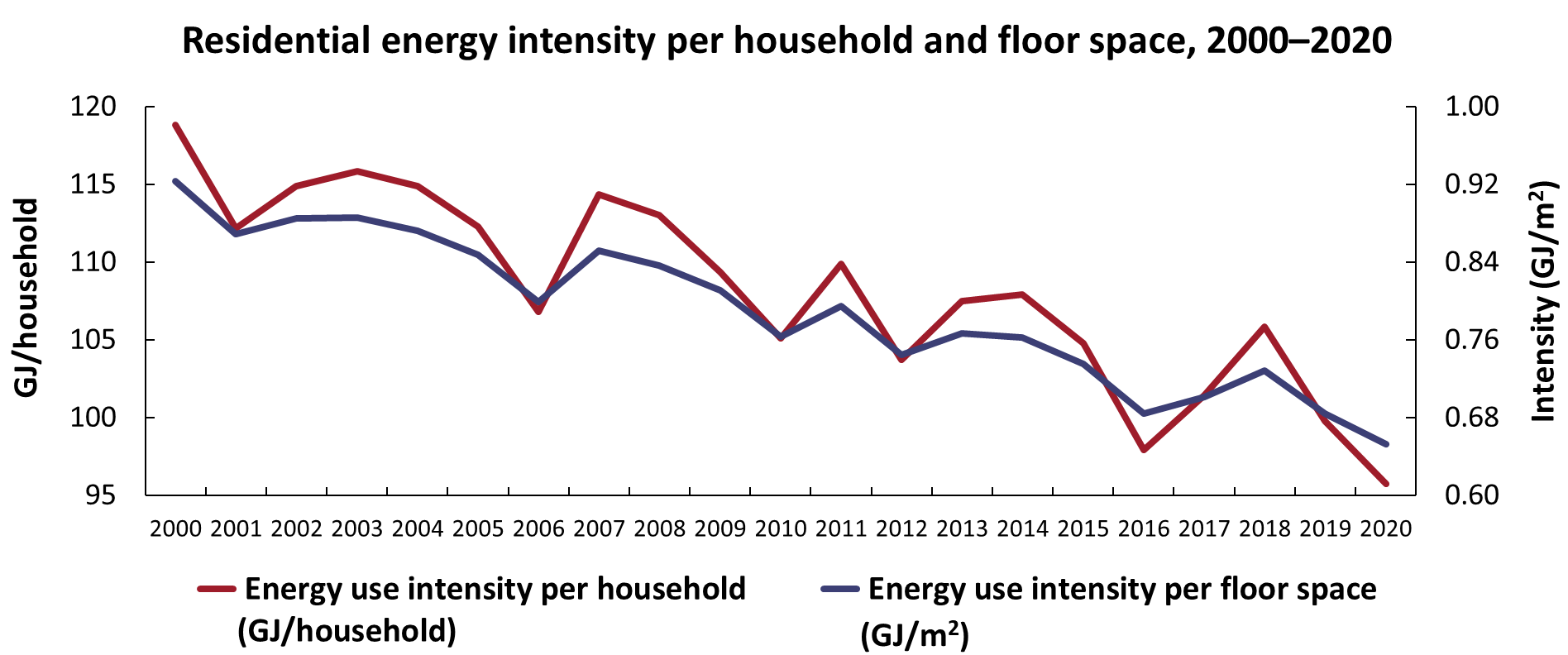
Residential energy intensity per household and floor space, 2000–2020
| Energy intensity per household (GJ/household) | Energy intensity per floor space (GJ/m2) | |
|---|---|---|
| 2000 | 118.82 | 0.92 |
| 2001 | 112.14 | 0.87 |
| 2002 | 114.86 | 0.88 |
| 2003 | 115.84 | 0.89 |
| 2004 | 114.90 | 0.87 |
| 2005 | 112.25 | 0.85 |
| 2006 | 106.80 | 0.80 |
| 2007 | 114.33 | 0.85 |
| 2008 | 113.01 | 0.84 |
| 2009 | 109.35 | 0.81 |
| 2010 | 105.06 | 0.76 |
| 2011 | 109.87 | 0.79 |
| 2012 | 103.69 | 0.74 |
| 2013 | 107.48 | 0.77 |
| 2014 | 107.92 | 0.76 |
| 2015 | 104.75 | 0.73 |
| 2016 | 97.92 | 0.68 |
| 2017 | 101.39 | 0.70 |
| 2018 | 105.83 | 0.73 |
| 2019 | 99.75 | 0.68 |
| 2020 | 95.70 | 0.65 |
Energy use per household and per unit of floor space has decreased significantly in the 2000-2020 period, driven by energy efficiency improvements across various residential energy end uses and energy sources.
 Energy efficiency
Without energy efficiency gains, energy use would have increased 35.2% instead of 3.2%.
Energy efficiency improvement is measured by estimating:
- the residential sector’s growth;
- changes in the composite of houses by type (structure effect);
- the rising number of appliances and electronic devices;
- the weather;
- other factors.
Text version
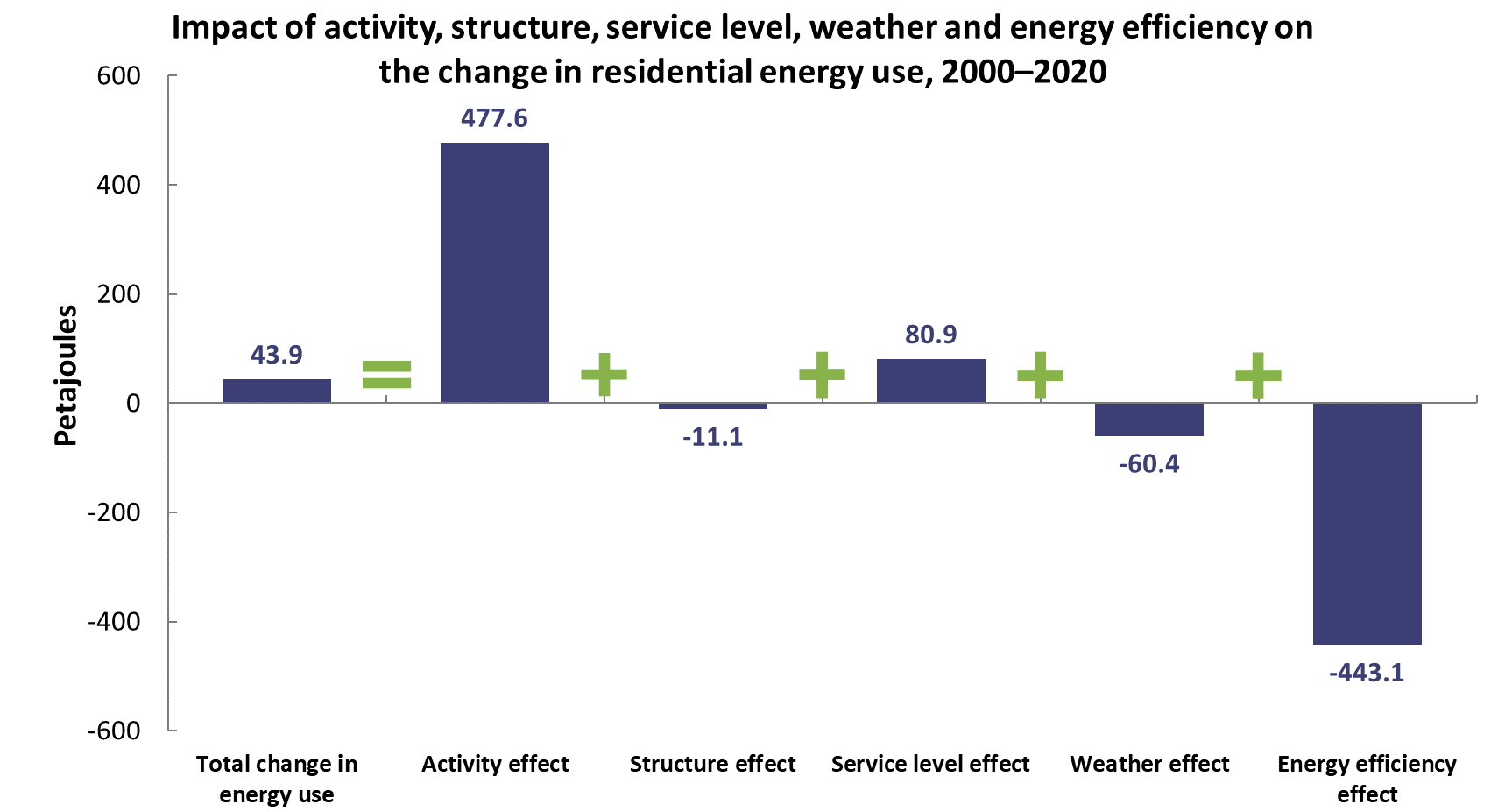
Impact of activity, structure, service level, weather and energy efficiency on the change in residential energy use, 2000–2020
| Petajoules | |
|---|---|
| Total change in energy use | 43.9 |
| Activity effect | 477.6 |
| Structure effect | -11.1 |
| Service level effect | 80.9 |
| Weather effect | -60.4 |
| Energy efficiency effect | -443.1 |
- Activity effect – A 28% increase in the number of Canadian households and a 14% increase in the average floor space resulted in an increase of 477.6 PJ in energy use and 19.1 Mt in GHG emissions.
- Structure effect – The structural change for the residential sector reflects mainly changes in its composition. For the 2000–2020 period, the share of single attached houses increased 1.7 percentage points, and that of apartments increased 1.4 percentage points, while the share of single detached houses dropped 2.9 percentage points. This structural change resulted in a decrease of 11.1 PJ in energy and 0.4 Mt in GHG emissions.
- Service level effect – An increase in the number of appliances, including electronics (e.g., home computers, video consoles and home entertainment systems) resulted in an increase of 80.9 PJ in energy and 3.2 Mt in GHG emissions.
- Weather effect – In 2020, the winter was among the warmest in 20 years, although the summer was among the hottest. As a result, the weather conditions resulted in a decrease of 60.4 PJ in energy use and 2.4 Mt in GHG emissions.
- Energy efficiency effect – The 32% improvement in energy efficiency saved 443.1 PJ in energy use, $8.7 billion in energy costs and avoided 17.7 Mt of GHG emissions.
The energy efficiency savings of 443.1 PJ offset 79% of the impact of higher levels of activity and service.
Residential energy use, with and without energy efficiency improvements, 2000–2020
Text version
Residential energy use, with and without energy efficiency improvements, 2000–2020
| Energy use with energy efficiency improvements | Energy use without energy efficiency improvements | |
|---|---|---|
| 2000 | 1,384 | 1,384 |
| 2001 | 1,327 | 1,351 |
| 2002 | 1,380 | 1,438 |
| 2003 | 1,412 | 1,488 |
| 2004 | 1,422 | 1,502 |
| 2005 | 1,413 | 1,522 |
| 2006 | 1,362 | 1,484 |
| 2007 | 1,485 | 1,592 |
| 2008 | 1,488 | 1,633 |
| 2009 | 1,467 | 1,669 |
| 2010 | 1,406 | 1,601 |
| 2011 | 1,489 | 1,663 |
| 2012 | 1,421 | 1,631 |
| 2013 | 1,491 | 1,737 |
| 2014 | 1,510 | 1,812 |
| 2015 | 1,481 | 1,781 |
| 2016 | 1,400 | 1,782 |
| 2017 | 1,457 | 1,823 |
| 2018 | 1,542 | 1,890 |
| 2019 | 1,473 | 1,939 |
| 2020 | 1,428 | 1,871 |
 Space heating
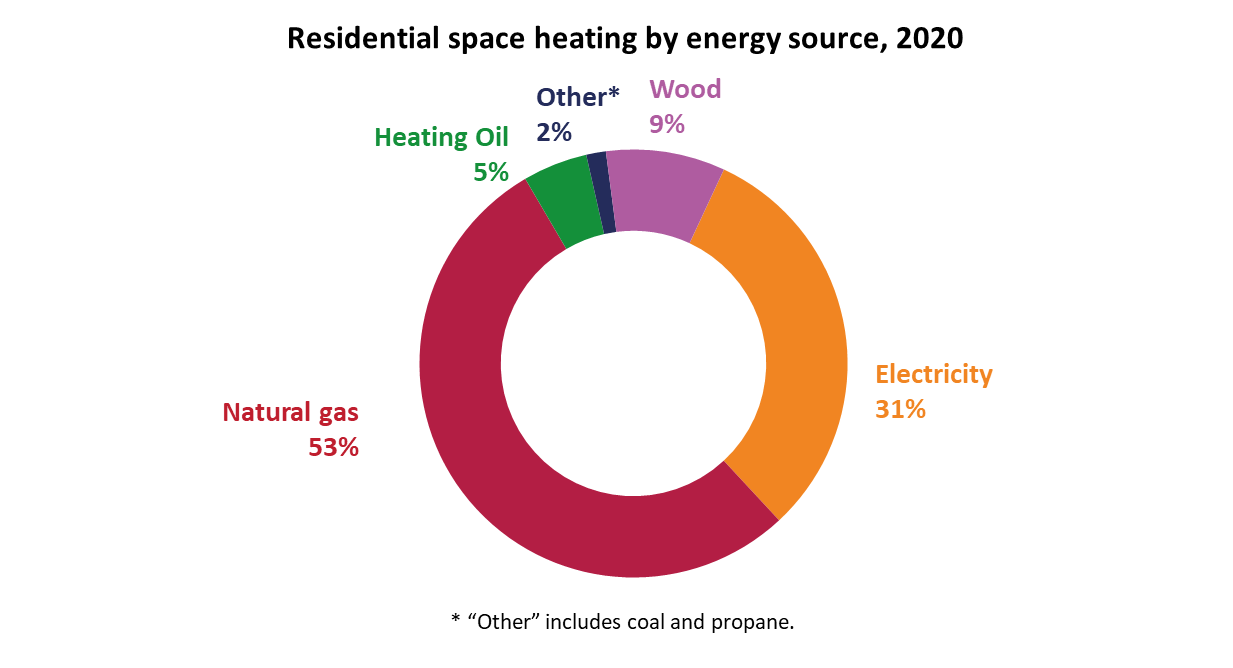
Space heating was the most consuming end use for residential energy, accounting for 61% of the total residential energy use. Natural gas accounted for over half (53%) of the total energy use for space heating. The greater penetration of high-efficiency natural gas furnaces contributed to the sector’s significant improvement in energy efficiency. These furnaces now account for 33.2% of all heating systems, up from 8.8% in 2000.
- installing weather-stripped doors and double-glazed windows;
- insulating basements, walls, ceilings and attics;
- using programmable thermostats;
- implementing more stringent building codes for new construction.
Text version
Residential space heating by energy source, 2020
| Fuel type | Percentage |
|---|---|
| Natural gas | 53 |
| Electricity | 31 |
| Wood | 9 |
| Heating oil | 5 |
| Other Footnote * | 1 |
Text version
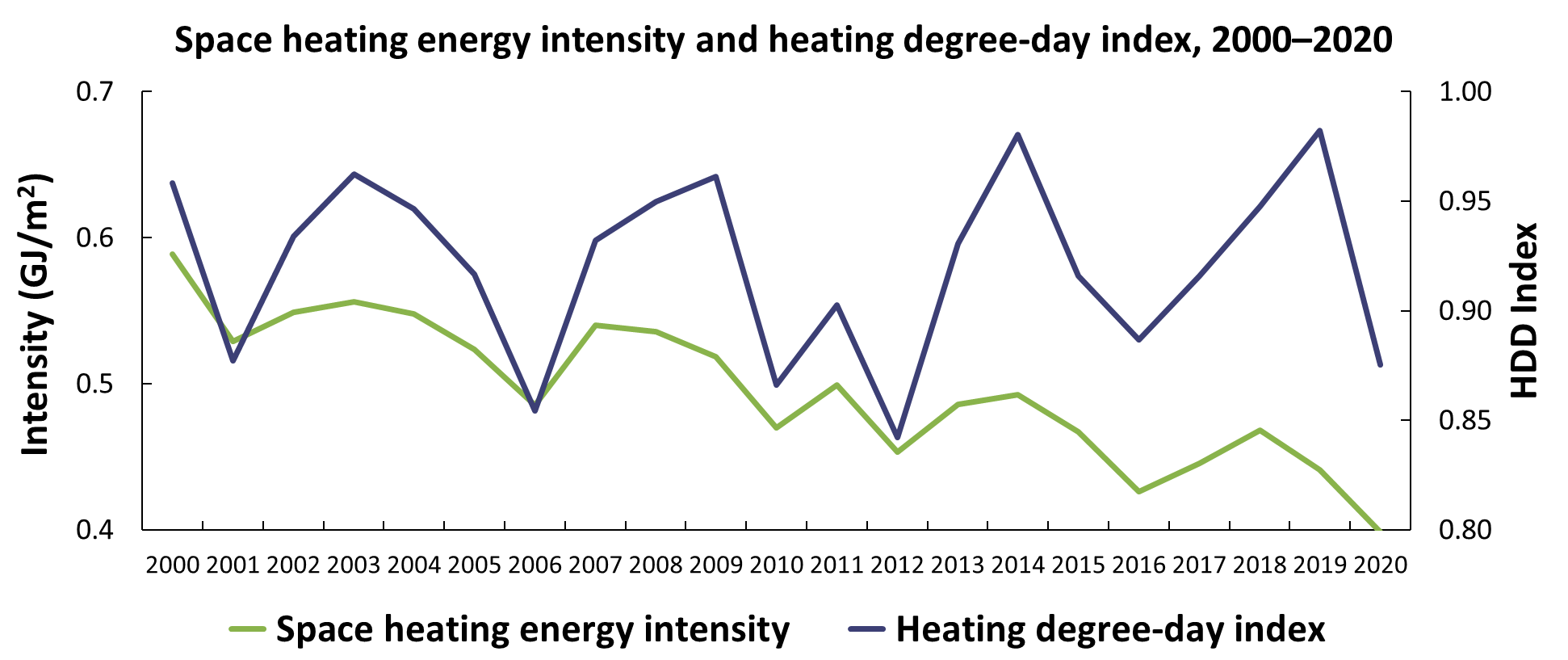
Space heating energy intensity and heating degree-day index, 2000–2020
| Space heating energy intensity | Heating degree-day index | |
|---|---|---|
| 2000 | 0.59 | 0.96 |
| 2001 | 0.53 | 0.88 |
| 2002 | 0.55 | 0.93 |
| 2003 | 0.56 | 0.96 |
| 2004 | 0.55 | 0.95 |
| 2005 | 0.52 | 0.92 |
| 2006 | 0.49 | 0.85 |
| 2007 | 0.54 | 0.93 |
| 2008 | 0.54 | 0.95 |
| 2009 | 0.52 | 0.96 |
| 2010 | 0.47 | 0.87 |
| 2011 | 0.50 | 0.90 |
| 2012 | 0.45 | 0.84 |
| 2013 | 0.49 | 0.93 |
| 2014 | 0.49 | 0.98 |
| 2015 | 0.47 | 0.92 |
| 2016 | 0.43 | 0.89 |
| 2017 | 0.45 | 0.92 |
| 2018 | 0.47 | 0.95 |
| 2019 | 0.44 | 0.98 |
| 2020 | 0.40 | 0.88 |
 Water heating
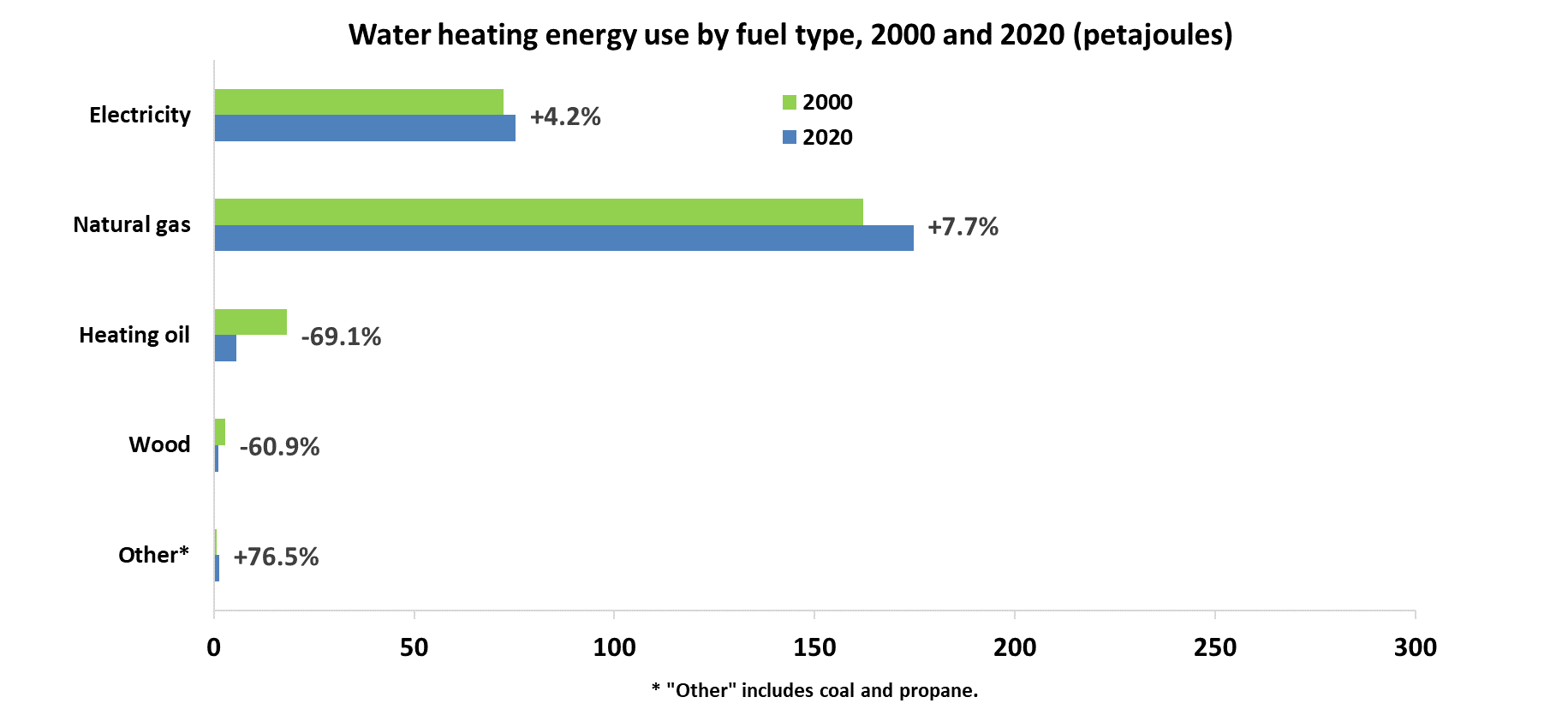
Water heating was the second most consuming residential energy end use. A shift from oil-fired water heaters to more efficient natural gas heaters and the implementation of more stringent energy standards for all water heaters helped lower energy use per household for water heating. Canadians have also altered energy consumption in water heating by switching to efficient practices such as:
- using tankless water heaters;
- installing low-flow fixtures on showerheads and faucets;
- running full loads in dishwashers and clothes washers;
- using cold water for laundry.
Text version
Water heating energy use by fuel type, 2000 and 2020 (petajoules)
| 2000 | 2020 | Growth/decrease (%) | |
|---|---|---|---|
| Electricity | 72.4 | 75.4 | 4.2 |
| Natural gas | 162.2 | 174.7 | 7.7 |
| Heating oil | 18.2 | 5.6 | -69.1 |
| Wood | 2.8 | 1.1 | -60.9 |
| Other Footnote * | 0.7 | 1.3 | 76.5 |
Energy use for residential water heating increased marginally from 256.3 PJ in 2000 to 258.1 PJ in 2020, as much of the impact of rising household numbers was offset by efficiency improvement.
 Appliances
The introduction of minimum energy performance standards under the Energy Efficiency Act (SC 1992, c.36) has contributed significantly to the dramatic energy efficiency improvement of major appliances and electronics used in Canadian homes.
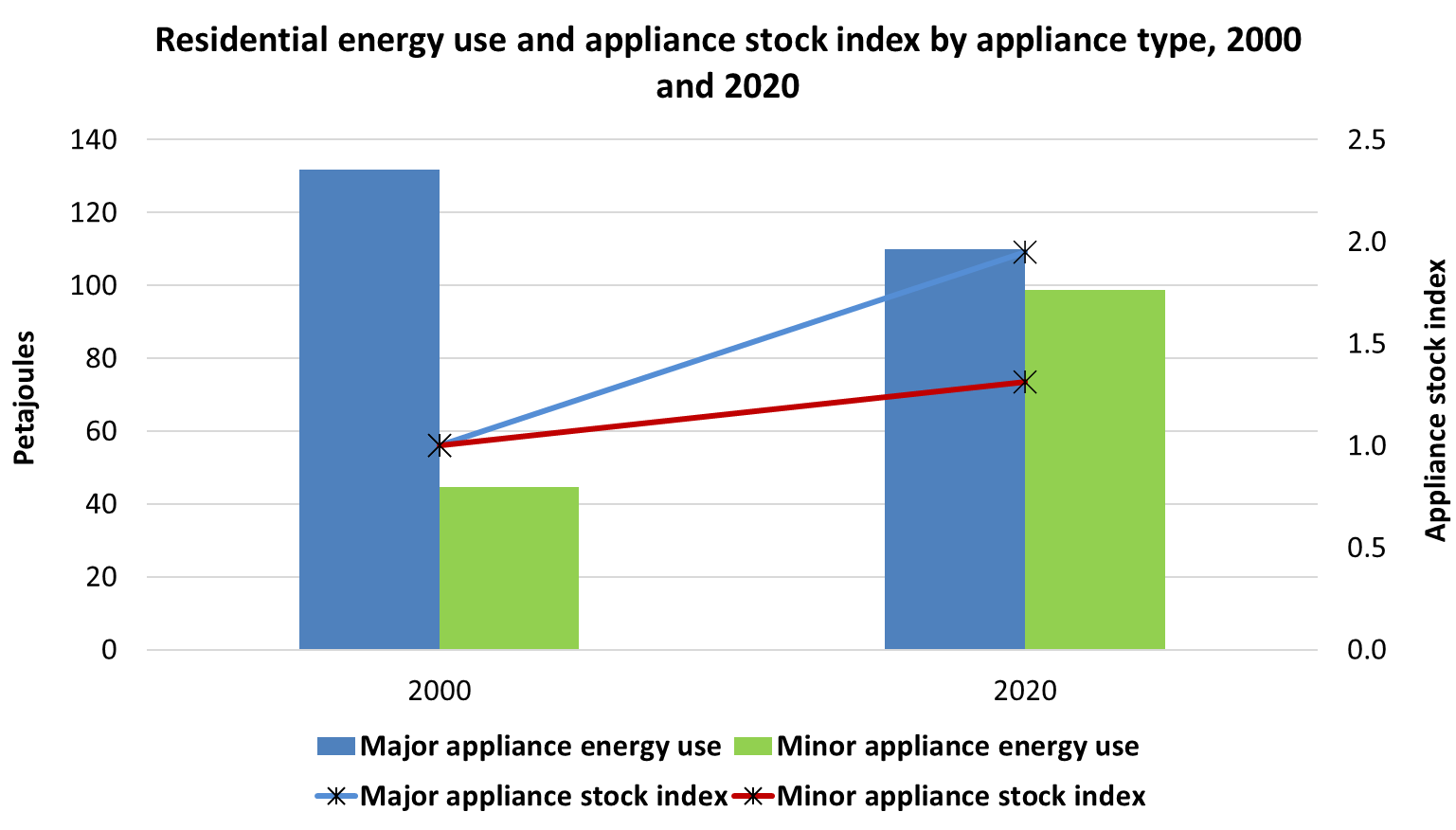
The energy efficiency of all appliances improved. However, energy savings from major appliances were exceeded by the increase in energy use for minor appliances, such as electronic devices.
Text version
Residential energy use and appliance stock index by appliance type, 2000 and 2020
| 2000 | 2020 | |
|---|---|---|
| Major appliance energy use (petajoules) | 132 | 110 |
| Minor appliance energy use (petajoules) | 45 | 99 |
| Major appliance stock index | 1.00 | 1.95 |
| Minor appliance stock index | 1.00 | 1.31 |
Text version
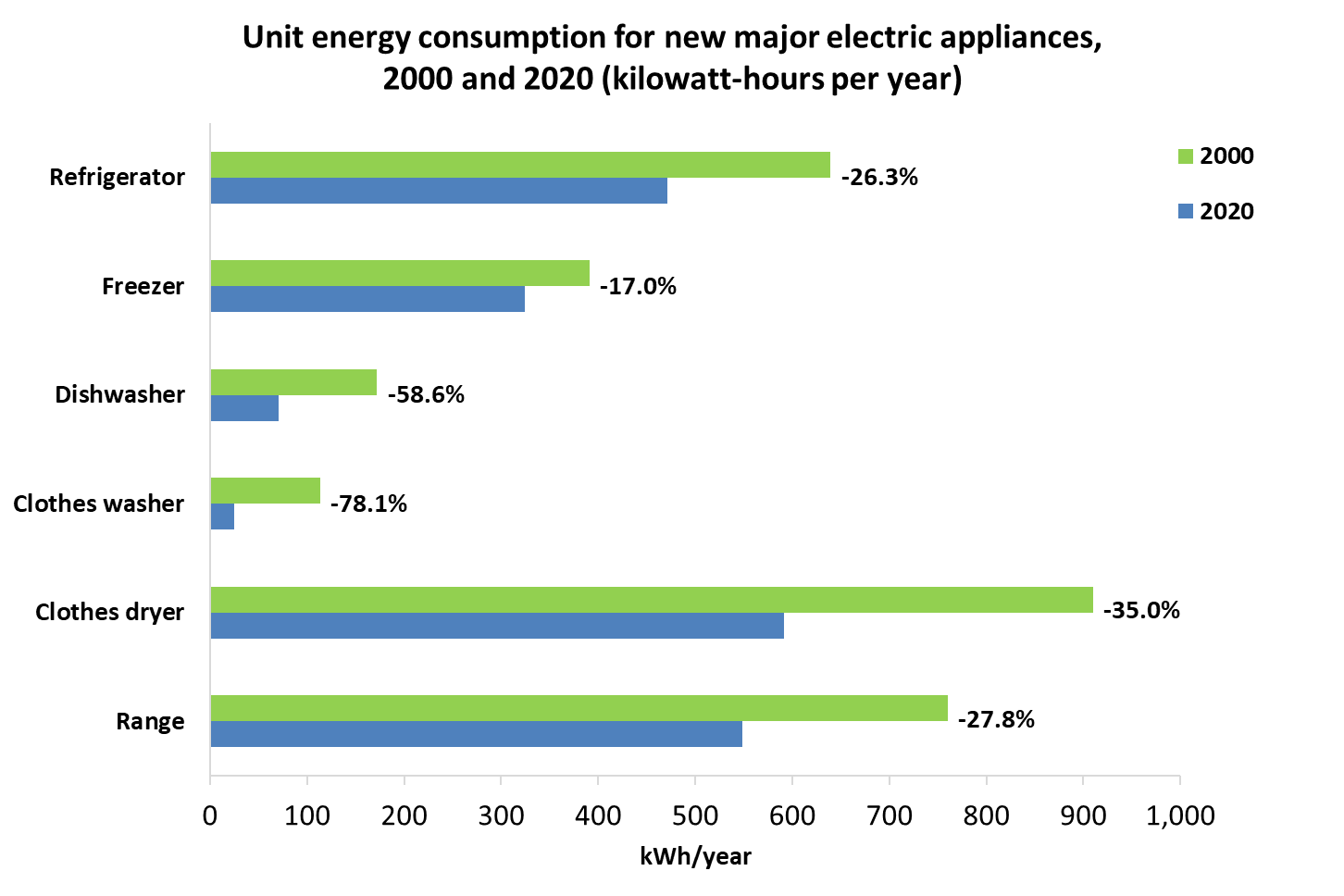
Unit energy consumption of new major electric appliances, 2000 and 2020 (kilowatt-hours per year)
| 2000 | 2020 | Growth/decrease (%) | |
|---|---|---|---|
| Refrigerator | 640 | 471 | -26.3 |
| Freezer | 391 | 324 | -17.0 |
| Dishwasher | 172 | 71 | -58.6 |
| Clothes washer | 113 | 25 | -78.1 |
| Clothes dryer | 910 | 591 | -35.0 |
| Range | 760 | 548 | -27.8 |
A dishwasher purchased in 2020 was nearly 60% more energy efficient than one manufactured in 2000. A clothes washer purchased in 2020 required less than one quarter of the energy needed for one manufactured in 2000. While the number of major appliances used in households increased 31%, energy consumption decreased 16%.
The energy used to power smaller appliances, such as televisions, computers and mobile phones more than doubled in the past 20 years, and the lower energy use per unit could only partially offset that of the rising numbers of minor appliances.
For the 2000 – 2020 period, the number of mobile phones used in Canada is estimated to have more than tripled from 8.7 million to 29.1 million. For the same period, the number of households with internet access more than doubled, from 6 million to 13.0 million.
The 54 PJ increase in minor appliances energy use was partially offset by the 22 PJ decrease in major appliances energy use.
 Space cooling
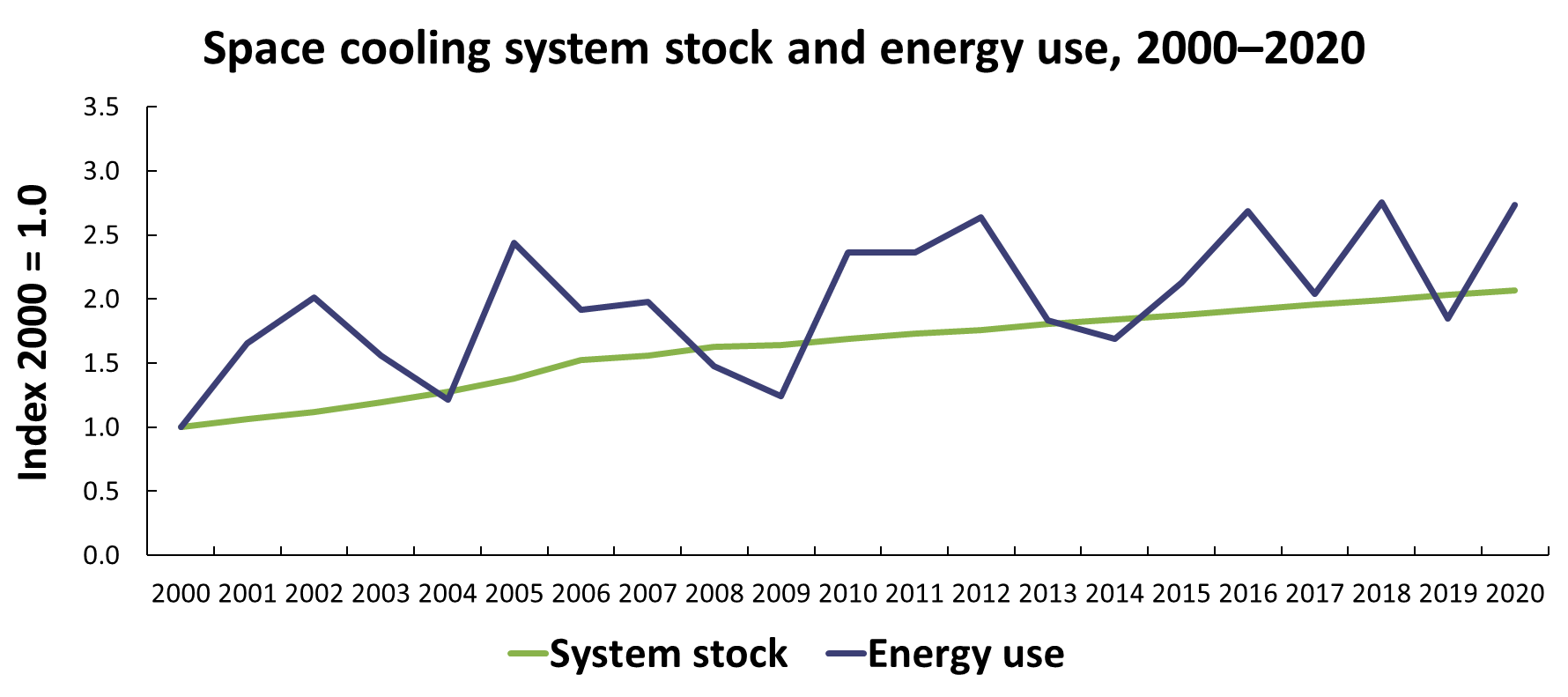
Between 2000 and 2020, the energy used to cool homes increased from 13 PJ to 36 PJ. This increase would have been higher without more efficient room and central air conditioners.
Text version
Space cooling system stock and energy use, 2000–2020
| System stock | Energy use | |
|---|---|---|
| 2000 | 1.00 | 1.00 |
| 2001 | 1.06 | 1.66 |
| 2002 | 1.12 | 2.01 |
| 2003 | 1.19 | 1.56 |
| 2004 | 1.28 | 1.22 |
| 2005 | 1.38 | 2.44 |
| 2006 | 1.52 | 1.92 |
| 2007 | 1.56 | 1.98 |
| 2008 | 1.63 | 1.48 |
| 2009 | 1.64 | 1.24 |
| 2010 | 1.69 | 2.36 |
| 2011 | 1.73 | 2.36 |
| 2012 | 1.76 | 2.64 |
| 2013 | 1.80 | 1.83 |
| 2014 | 1.84 | 1.69 |
| 2015 | 1.88 | 2.13 |
| 2016 | 1.92 | 2.69 |
| 2017 | 1.95 | 2.04 |
| 2018 | 1.99 | 2.76 |
| 2019 | 2.03 | 1.85 |
| 2020 | 2.07 | 2.74 |
Along with increases in the number and size of households, more Canadians have air conditioners at home, significantly increasing energy use for cooling. Meanwhile, cooling energy use varies annually depending on the weather conditions of a given summer. However, Canadians helped offset some of the energy consumption by using:
- ENERGY STAR ™ certified room or central air conditioners;
- programmable thermostats.
In 2020, room and central air conditioners were respectively 42% and 34% more energy-efficient compared to 2000.
 Lighting
The increased use of energy-saving light bulbs, such as LEDs (light-emitting diodes), led to a decrease of 25%, from 4.7 GJ to 3.5 GJ, in lighting energy use per household thanks to the following practices:
- using LED light bulbs;
- using outdoor lights with motion detectors;
- using timers for holiday lights;
- turning off unnecessary lights;
- using task lighting instead of ceiling lights;
- choosing light bulbs with a wattage matching the purpose of the room or area;
- using multiple switches in a given room or area;
- using light dimmers.
Text version
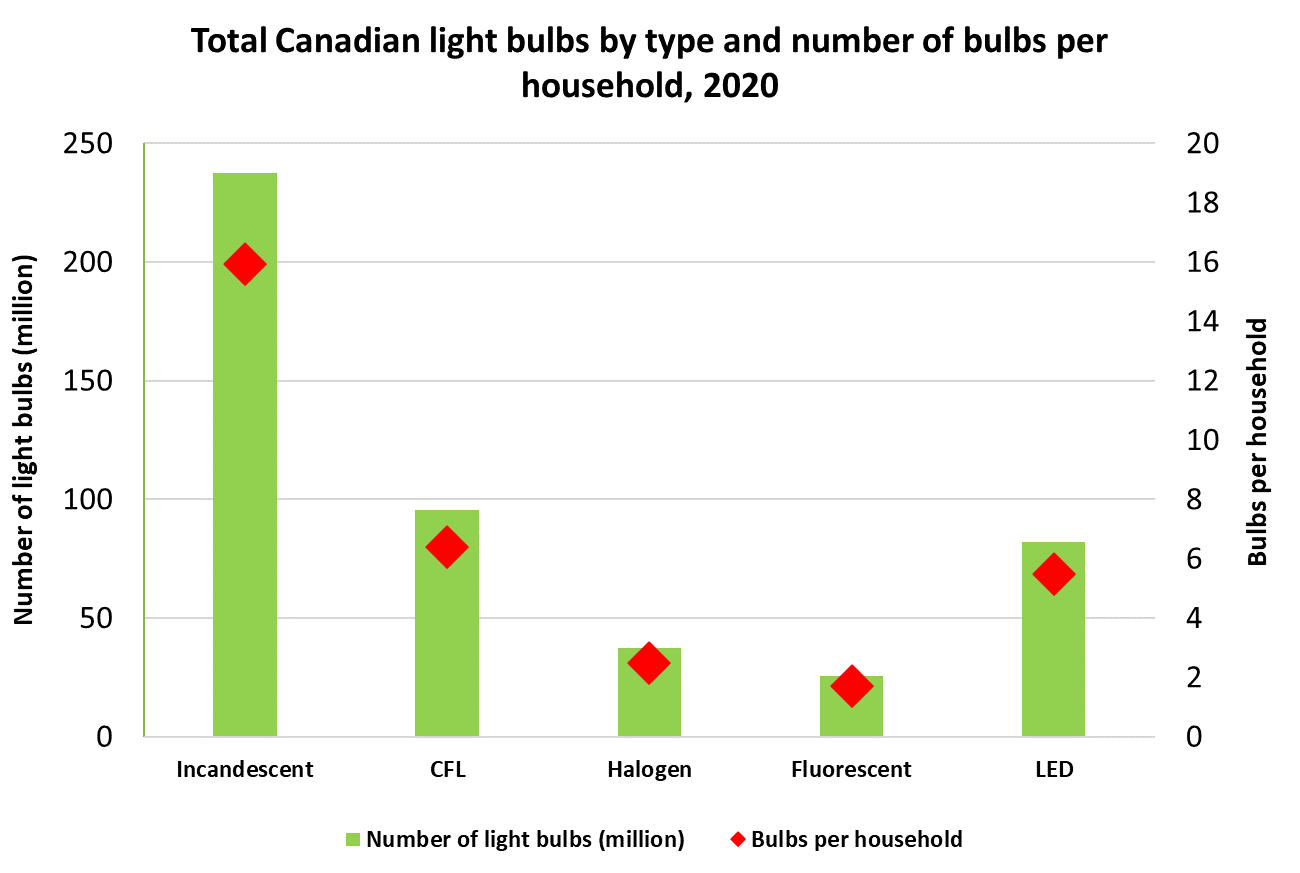
Total Canadian light bulbs by type and number of bulbs per household, 2020
| Number of light bulbs | Bulbs per household | |
|---|---|---|
| Incandescent | 237,671,662 | 15.92 |
| CFL | 95,488,377 | 6.40 |
| Halogen | 37,211,896 | 2.49 |
| Fluorescent | 25,666,324 | 1.72 |
| LED | 81,807,974 | 5.48 |
| Total Stock | 477,846,233 | 32.02 |